Author :Lily
DTF transfer film is a precision-coated consumable. Even when a film performs well during printing, unsuitable storage conditions can affect its surface, coating and handling characteristics before it reaches the printer. Humidity is a particular concern for distributors, printing workshops and manufacturers operating in tropical climates, coastal regions or warehouses without consistent environmental control.
Understanding how to store DTF transfer film is therefore an important part of maintaining consistent printing results and reducing material waste. Storage is not simply a matter of keeping rolls clean. It involves controlling moisture exposure, protecting the original packaging, preventing physical damage and managing inventory turnover.
For businesses purchasing DTF film in bulk, these precautions are especially important. A roll may spend weeks in a warehouse or several weeks in international transportation before it is opened and used. The film needs protection throughout this period.
What Is the Best Way to Store DTF Transfer Film?
Store DTF transfer film in its original sealed packaging, in a clean and dry warehouse, and keep rolls elevated on shelves or pallets rather than placing them directly on the floor. In particularly humid environments, keeping the film away from damp walls and potential water sources is also important.
We recommend using the film within three months whenever possible. If a roll will not be used immediately, do not open its packaging. Keeping the film sealed helps reduce unnecessary exposure to moisture and airborne contaminants.
Packaging also matters. Saillage has updated its packaging to use aluminum laminated material, with an approximately 80% improvement in moisture resistance in internal comparative testing. For transportation, rolls are additionally protected with bubble wrap or air-column cushioning to reduce impact damage.
Key Takeaways
- ✔ Store DTF film in a dry, clean environment and keep it off the warehouse floor.
- ✔ Keep unused rolls sealed in their original packaging.
- ✔ Aim to use the film within three months, subject to the manufacturer’s storage guidance.
- ✔ Aluminum laminated packaging can provide an improved moisture barrier.
- ✔ Use cushioning during shipping to protect rolls from impact and deformation.
1. Why Does Proper DTF Film Storage Matter?
DTF film performance depends on more than the PET base material. The coating on the film surface is designed to receive printing ink and support the transfer process. Changes in storage conditions can affect how consistently that coated surface performs.
1.1 Moisture and humidity
High humidity does not automatically mean that every DTF film roll will become unusable. However, prolonged or direct moisture exposure can create problems, particularly when packaging is damaged or opened. Potential issues include:
• Changes in the condition of the coating surface.
• Uneven ink behavior during printing.
• Inconsistent powder application or release.
• Surface contamination caused by condensation or contact with damp materials.
• Reduced consistency between rolls stored under different conditions.
The actual impact depends on the PET substrate, coating formulation, packaging barrier and length of exposure. It is therefore important to distinguish between a film’s ability to absorb printing ink and its resistance to environmental moisture.
A well-designed DTF coating should provide suitable ink receptivity without making the film unnecessarily vulnerable to moisture. Some of the specialty materials selected for our products are imported materials chosen for their ink-receptive performance and moisture-related characteristics. Their performance is evaluated as part of our material and quality-control process.
1.2 Dust, contamination and physical damage
Moisture is not the only storage risk. Dust, oil, fingerprints and scratches can also affect the usable film surface. A roll stored in an open or poorly organized warehouse may collect contaminants around its edges or on exposed surfaces. Heavy objects placed on top of rolls can also cause deformation, while careless handling can damage the edges.
2. How to Store DTF Transfer Film in Humid Environments
2.1 Keep film rolls off the floor
In particularly humid environments, we recommend never placing DTF film rolls directly on the warehouse floor. Concrete floors can retain moisture, especially in warehouses with poor ventilation, temperature fluctuations or limited waterproofing.
• Keep film rolls on clean warehouse shelves or pallets.
• Maintain a clear distance between the rolls and the floor.
• Avoid placing rolls next to damp walls, windows or leaking pipes.
• Check storage areas regularly for signs of condensation or water leakage.
• Keep the storage area clean and avoid stacking unrelated materials on top of the film.
2.2 Keep unused rolls in sealed packaging
If a roll is not going to be used immediately, do not open the original packaging. Once packaging is opened, the film is exposed to the surrounding environment. In a humid warehouse, repeated exposure during storage can increase the risk of moisture-related changes and contamination.
2.3 Use the film within three months
For practical inventory management, we recommend using DTF transfer film within three months of receipt whenever possible. For distributors and large-volume printing operations, the first-in, first-out (FIFO) principle is useful:
• Label each shipment with its receiving date.
• Arrange older stock so it is used first.
• Avoid purchasing more material than the warehouse can store properly.
• Inspect older stock before putting it into production.
3. Packaging: An Important Part of Moisture Protection
3.1 Why aluminum laminated packaging matters
Saillage has updated its DTF film packaging by introducing aluminum laminated material to improve moisture protection. This updated packaging has demonstrated an approximately 80% improvement in moisture resistance in internal comparative testing.
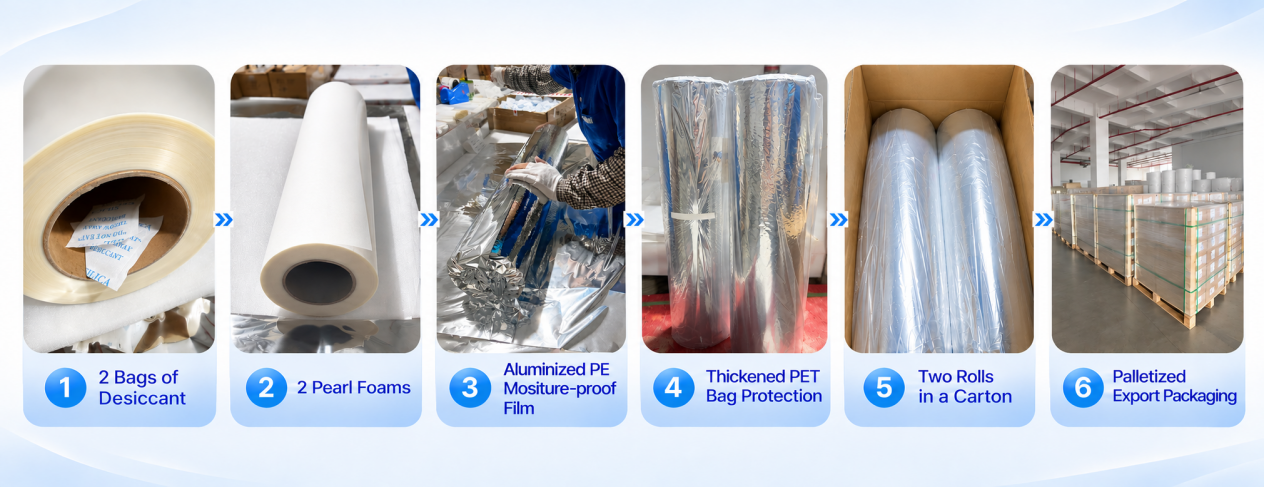
3.2 Packaging must protect the film during transportation, too
DTF film rolls can also be affected by impact, compression and rough handling. For courier shipments, we use protective materials such as:
Bubble wrap: Used to wrap the film roll; Air-column cushioning: Provides additional cushioning; Protective outer packaging: Helps keep the cushioning in position.
4. How to Protect DTF Film During Long-Distance Sea Freight
Sea freight presents a different storage challenge. Temperature changes can cause moisture in the air to condense on container surfaces, known as container rain.
4.3 Traditional packaging vs. an improved protection approach
| Evaluation factor | Basic protection approach | Recommended protection approach |
|---|---|---|
| Moisture protection | Standard packaging | Aluminum laminated packaging |
| Warehouse storage | On the floor | Shelves or pallets |
| Unused material | Opened early | Keep sealed until needed |
| Inventory management | No fixed rotation | FIFO (within 3 months) |
| Transportation | Basic carton | Bubble wrap / Air-column |
5. A Practical DTF Film Storage Checklist
When receiving
• Check for outer damage/wetness
• Inspect roll edges and cores
• Record date and batch info
• Move to dry storage area
During storage
• Store on shelves, not floor
• Keep away from damp walls
• Do not open packaging early
• Use older inventory first
6. Frequently Asked Questions
Q: How should DTF transfer film be stored in a humid environment?
Keep it in original sealed packaging, on shelves/pallets, away from damp walls and direct sunlight. Keep rolls sealed until needed.
Q: How long can DTF transfer film be stored before use?
We recommend using it within three months of receipt. Actual life depends on coating and warehouse conditions.
Q: Does moisture affect DTF transfer film printing quality?
Yes. It can lead to uneven ink behavior, coating changes, or inconsistent powder application.
7. Protect Your DTF Film from the Warehouse to the Printer
At Saillage, we focus on film performance as well as packaging and transportation protection. If you are sourcing DTF transfer film for distribution or production, contact our team to discuss film specifications, packaging options and sample testing.
Post time: Nov-17-2026