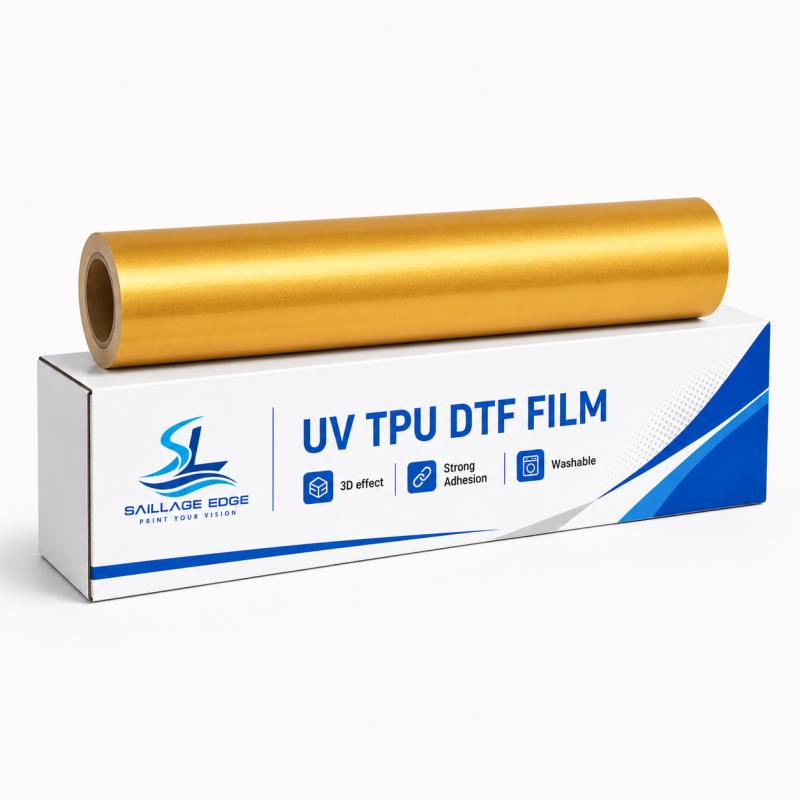
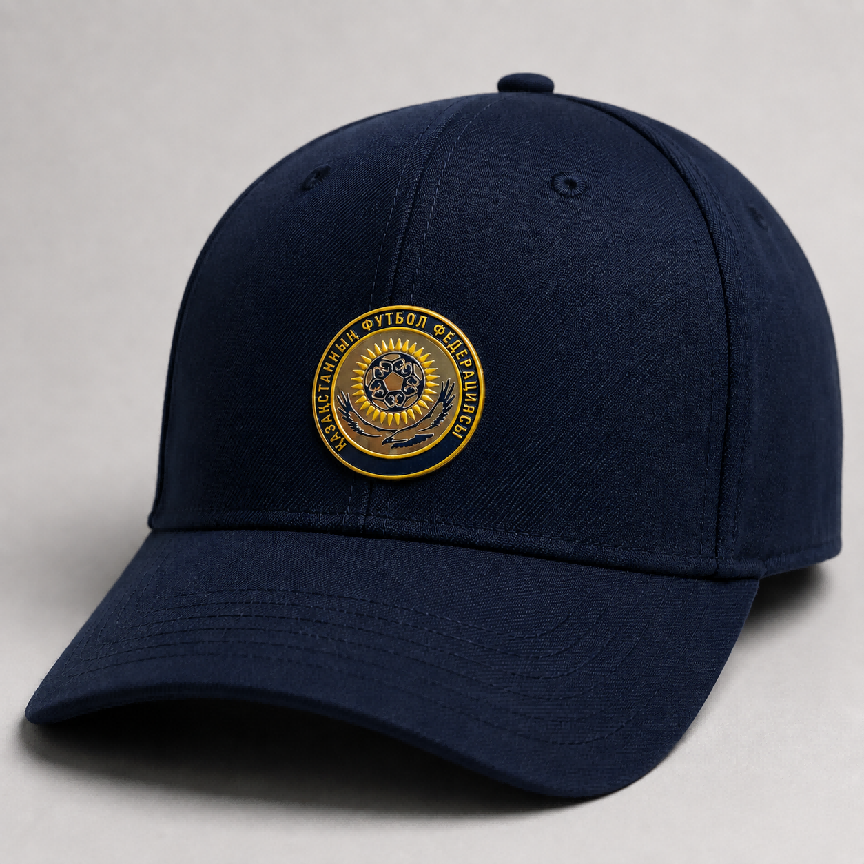
Metallic gold logos are widely used in sportswear, fashion apparel, uniforms, premium promotional garments, and branded merchandise. The technical challenge is not simply producing a gold color. A successful premium logo must combine metallic visual impact, clear edge definition, dimensional texture, flexibility, and reliable durability after transfer.
This is where 3D UV TPU Film, 3D UV DTF printing, and advanced 3D Logo heat transfer technology provide a different approach from conventional flat textile printing. By combining a flexible TPU-based transfer structure with high-definition printing and a three-dimensional embossed effect, the process can create logos with more visible depth and a premium tactile appearance.
For DTF distributors, apparel customization businesses, printing service providers, and printing equipment wholesalers, understanding how this material works is important when evaluating whether it fits a particular decoration application.
Key Takeaways
- · 3D UV TPU Film is designed to create a raised, dimensional logo effect rather than a conventional flat print.
- · The flexible TPU material helps the transferred logo better follow the movement and deformation of garments.
- · 3D UV DTF printing can support detailed logo reproduction, including fine lines, small text, and complex graphic elements.
- · Metallic gold visual effects depend on the complete printing and transfer system, including artwork design, ink performance, material structure, and process control.
- · UV TPU 3D film is particularly suitable for applications requiring a premium logo transfer solution with texture, flexibility, and strong visual differentiation.
1. Why Metallic Gold 3D Logos Are More Difficult Than Standard Garment Prints
A standard garment print primarily focuses on color reproduction and adhesion. A metallic gold 3D logo adds several additional requirements.
First, the logo must produce a visually convincing metallic appearance. Gold is highly sensitive to color deviation. If the tone is too yellow, too brown, or lacks contrast, the result can appear less premium. Second, the logo requires visible dimensionality. A true 3D Logo should create a noticeable difference between the decorated area and the surrounding fabric.
The third challenge is flexibility. Garments bend, stretch, fold, and experience repeated mechanical movement. A rigid decorative layer may look attractive before use but can become a concern when applied to flexible textile substrates. The transfer material therefore needs to balance dimensional structure and flexibility.
Traditional flat DTF printing can be effective for many textile graphics, but its surface is generally designed around flat image transfer. Conventional embroidery can create texture and height, but it may require more production time and may not be suitable for every small or highly detailed logo.
3D UV TPU Film addresses a different application category: it is intended to combine a raised visual effect with detailed printing and the flexible characteristics of TPU material. For customers searching for 3d uv tpu film, 3d uv dtf printing, 3D Logo, Heat transfer, Textile Printing, and DTF printing solutions, the key question is whether the finished logo can deliver the required appearance while remaining suitable for the intended garment and production process.
2. The Technical Core: How UV TPU 3D Film Creates a Raised Logo Effect
To evaluate a UV TPU 3D film, it is useful to separate the system into three technical elements: material properties, structural design, and printing performance.
2.1 Flexible TPU Material
TPU, or thermoplastic polyurethane, is commonly valued for its combination of flexibility and mechanical performance. In a transfer application, flexibility is particularly important because the finished decoration is applied to a textile surface rather than a rigid substrate.
A TPU transfer film can help the transferred logo better accommodate normal garment movement. This is especially relevant for applications such as sportswear, jerseys, workwear, jackets, and other apparel that experiences repeated bending and handling.
The material does not eliminate the need for proper process control. Final performance still depends on factors such as:
- •TPU formulation and film structure
- •Printing compatibility
- •Ink curing performance
- •Transfer conditions
- •Adhesion system
- •Fabric composition
- •Garment surface treatment
- •Application and washing conditions
The practical objective is to create a logo that maintains its appearance while avoiding an unnecessarily rigid hand feel.
2.2 Three-Dimensional Structural Effect
The primary difference between a conventional flat transfer and a 3D texture transfer film is the surface profile.
A 3D transfer structure creates a physical height difference. When light reaches the raised surface and its surrounding edges, variations in reflection and shadow make the logo appear more dimensional. This visual mechanism is particularly useful for premium logos, emblems, lettering, and small brand marks.
For a metallic gold 3D logo, dimensionality can strengthen the metallic appearance because the raised surface provides additional visual contrast. The effect is not produced by color alone. It is the interaction of surface texture, height, edge definition, light reflection, and gold-toned graphics.
A well-controlled 3D logo should therefore consider:
Surface definition — Smooth and consistent surfaces can improve visual quality.
Edge sharpness — Clear edges are important for logos containing fine lettering or geometric shapes.
Dimensional consistency — Uneven height can negatively affect appearance.
Artwork compatibility — Extremely small details may require process evaluation before mass production.
2.3 Ultra-High-Definition Printing
Brand logos often contain small text, thin lines, gradients, or detailed symbols. Printing quality therefore has a direct impact on the commercial value of the finished transfer.
The source material identifies Ultra High Definition Printing as a core advantage. In practical production, high-definition output means that the complete system must be able to reproduce artwork with controlled detail and stable registration.
For metallic gold logos, print quality is especially important because imperfections are often more visible on premium decorative designs. Poor edge control, inconsistent coverage, or unstable production parameters can reduce the intended high-end appearance.
For this reason, smooth printing and stable production should be evaluated as production capabilities rather than treated as purely visual claims. A transfer material must be compatible with a repeatable workflow if it is intended for commercial-scale printing and distribution.
3. Application Scenarios and Practical Solutions
3.1 Sports Jerseys and Teamwear
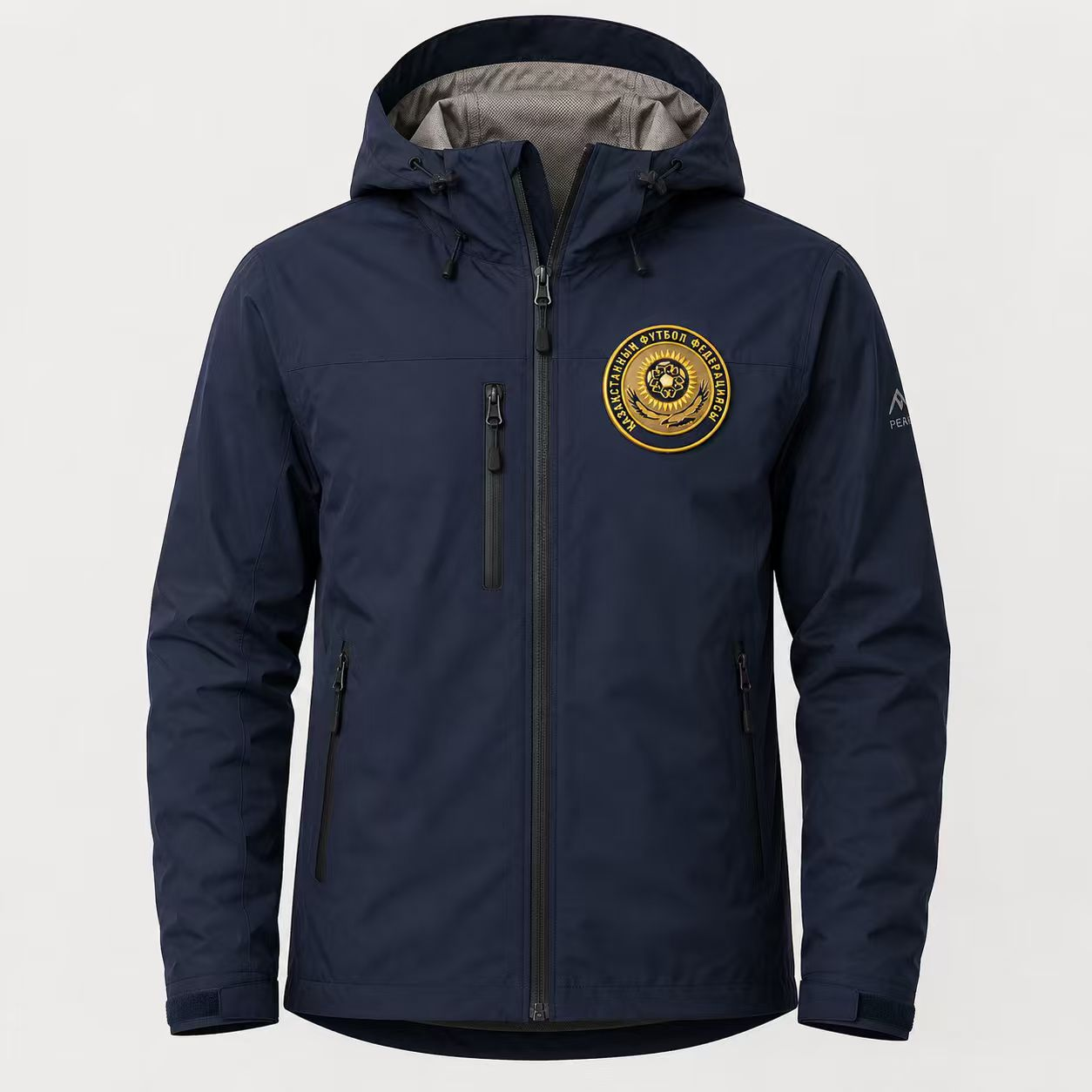
Sports jerseys frequently use player names, numbers, team logos, sponsor marks, and decorative badges. These applications require decoration that is visually distinctive without unnecessarily limiting garment movement.
A flexible UV transfer film can be considered for raised logos where a conventional flat print does not provide sufficient visual differentiation.
Potential applications include:
- •Team emblems
- •Sponsor logos
- •Premium club marks
- •Decorative name badges
- •Limited-edition metallic gold graphics
- •Event and tournament apparel
For jerseys, the relationship between the transfer material and the stretch characteristics of the fabric should be evaluated before production. Highly elastic fabrics and different knit structures may require application testing under typical use conditions.
3.2 Fashion Apparel and Premium Brand Decoration
Fashion brands often use logos as part of the product’s visual identity. A flat printed logo may provide sufficient information, but a raised logo can add tactile and visual differentiation.
Metallic gold 3D effects are particularly relevant when the brand wants to communicate:
- •Premium positioning
- •Limited-edition design
- •Dimensional texture
- •Visible branding
- •Decorative contrast with dark or solid-color garments
The combination of UV DTF TPU film and 3D texture can allow designers to explore logo applications that sit between conventional flat printing and more traditional dimensional decoration methods.
3.3 Workwear and Corporate Apparel
Corporate uniforms often require consistent logo reproduction across multiple garments and production batches. Printing service providers need a solution that supports recognizable branding, fine details, and stable output.
A premium logo transfer solution may be considered when:
- •The company logo requires more visual presence.
- •The customer wants a premium decorative finish.
- •Small or detailed logo elements need clear reproduction.
- •The printing business needs a repeatable workflow.
For corporate orders, production consistency is usually as important as the initial appearance. Before supplying a large project, printers should evaluate artwork, garment material, transfer settings, and production repeatability.
3.4 Apparel Customization and On-Demand Printing
Customization businesses often need to handle short runs, multiple designs, and frequent artwork changes. A transfer-based workflow can offer operational advantages because graphics can be prepared separately from the final garment decoration stage.
This may be useful for:
- •Custom sportswear
- •Personalized apparel
- •Promotional garments
- •Brand merchandise
- •Event clothing
- •Small-batch fashion products
For these users, the value of a 3D UV DTF printing workflow is not only the final 3D appearance. Production efficiency also depends on whether the material supports smooth printing and stable handling throughout the process.
3.5 DTF Distributors and Printing Equipment Wholesalers
For distributors and wholesalers, product selection should extend beyond the statement that a film can produce a 3D effect.
Technical valuation should include:
- ☑ Material consistency: Check whether the TPU film structure performs consistently between production batches.
- ☑ Print compatibility: Confirm compatibility with the intended printing equipment, ink system, and workflow.
- ☑ Detail reproduction: Test fine text, thin lines, and small logo elements.
- ☑ Dimensional quality: Evaluate whether the 3D effect is visually consistent across the transfer.
- ☑ Flexibility: Assess the finished logo after normal bending and garment movement.
- ☑ Application range: Test representative garment materials used by target customers.
- ☑ Production stability: Evaluate print smoothness and consistency during continuous production.
- ☑ Sample validation: Use customer artwork and real garment substrates rather than relying only on standard test images.
Traditional Solutions vs. 3D UV TPU Film
| Evaluation Area | Conventional Flat Textile Transfer | Embroidery / Conventional Raised Decoration | 3D UV TPU Film Solution |
|---|---|---|---|
| Visual surface | Generally flat | Raised texture | Designed for a visible 3D embossed effect |
| Fine graphic detail | Can support detailed graphics | Fine details may be limited by stitch structure | Suitable for detailed printed logo designs, subject to process capability |
| Flexibility | Depends on transfer material | Depends on thread density and backing | Flexible TPU material is a core design characteristic |
| Metallic gold effect | Primarily dependent on ink/color system | Depends on thread or material selection | Can combine metallic visual design with a raised surface effect |
| Production workflow | Common transfer workflow | Requires embroidery process | Transfer-based printing and application workflow |
| Logo appearance | Primarily color and graphic-based | Textile texture and dimensionality | Combines printed graphics with 3D texture |
| Application focus | General garment graphics | Textured and traditional premium decoration | Premium logos, emblems, and dimensional brand graphics |
The comparison is application-specific. No single decoration method is automatically suitable for every logo. The correct choice depends on artwork, garment material, order volume, required texture, production equipment, and target cost.
4. How to Select a UV DTF TPU Film for Metallic Gold 3D Logo Production
Selecting a UV TPU 3D film should involve a technical evaluation rather than relying only on a finished sample image.
1 Step 1: Start With the Artwork
Review the logo before selecting the transfer solution.
Check:
- •Minimum line thickness
- •Small text size
- •Fine edge details
- •Solid areas
- •Required metallic appearance
- •Required 3D height and texture
Artwork that looks effective on a digital screen may not automatically produce the same result after printing and transfer.
2 Step 2: Define the Garment Substrate
Identify whether the target garment is made from:
- •Cotton
- •Polyester
- •Cotton-polyester blends
- •Stretch fabrics
- •Sportswear fabrics
- •Other specialized textiles
The material selection and application process should be validated against the actual garment substrate.
3 Step 3: Conduct Sample Testing
A representative test should evaluate more than initial visual appearance. Under typical application conditions, check:
- •Logo edge quality
- •Surface smoothness
- •3D appearance
- •Flexibility after transfer
- •Adhesion performance
- •Appearance after handling
- •Consistency across multiple samples
For commercial orders, sample approval with the customer’s actual artwork and garment is a practical way to reduce production uncertainty.
4 Step 4: Evaluate Production Stability
A film may produce an attractive result during a single test but still require further evaluation for continuous production. Printing companies should monitor whether the workflow remains stable during normal production. Important observations can include material handling, printing consistency, graphic definition, and batch-to-batch repeatability.
5 Step 5: Consider Environmental and Material Requirements
The source material identifies Eco-Friendly TPU Material as a product advantage. For B2B purchasing, environmental requirements should be discussed using the supplier’s actual material documentation, applicable regulations, and destination-market requirements.
Avoid assuming compliance with a particular certification unless the supplier can provide valid supporting documentation. This is especially important when products are sold into markets with specific chemical or environmental requirements.
5. Frequently Asked Questions
Q Is 3D UV TPU Film the same as standard DTF film?
No. The intended application described here focuses on a three-dimensional embossed logo effect using a flexible TPU-based transfer structure. Standard DTF printing is generally associated with flat graphic transfer. The exact construction and process should be confirmed with the material supplier.
Q Can UV TPU 3D Film create a metallic gold logo?
It can be used for metallic gold visual designs when the complete printing system and artwork are configured for that effect. Final appearance depends on the color system, surface structure, printing quality, and process control. A production sample is recommended before mass production.
Q Is a 3D TPU logo suitable for flexible garments?
Flexible TPU material is a key feature of this type of transfer film. However, suitability should be tested on the specific garment because fabric composition, stretch level, application conditions, and intended use can affect final performance.
Q What should distributors test before purchasing in volume?
Test print compatibility, logo detail, 3D consistency, material handling, production stability, flexibility, and performance on representative garment substrates. For large orders, request samples using actual customer artwork whenever possible.
6. A Practical Upgrade for Premium Garment Logo Decoration
For apparel businesses that need more than a flat printed mark, 3D UV TPU Film provides a material-based approach to creating visible depth, tactile texture, and detailed logo decoration. Its core value comes from the combination of a real 3D embossed effect, flexible TPU material, high-definition printing capability, stable production potential, durability, and broad garment application possibilities.
The best results begin with technical matching: evaluate the artwork, garment substrate, printing workflow, transfer process, and expected end-use conditions as one complete system.
If you are a DTF distributor, apparel customization company, printing service provider, or printing equipment wholesaler, request samples based on your actual logo artwork and target garments. A controlled sample test is the most practical way to evaluate whether a UV DTF TPU film solution meets your required appearance and production requirements.
Author:Jacky
Post time: Aug-18-2026