Introduction
Traditional DTF printing has become an established solution for textile decoration, but conventional DTF transfer film is primarily designed for flat, flexible graphics. For brands, apparel customization companies, and printing service providers looking for more distinctive 3D Logo effects, the challenge is no longer simply achieving high-resolution color—it is creating a visible, tactile surface while maintaining flexibility, durability, and production stability.
3D UV DTF TPU Film addresses this requirement by combining UV DTF printing technology with a flexible TPU-based transfer film designed for textured and dimensional logo applications. Compared with conventional flat DTF solutions, 3D UV DTF printing can provide a more pronounced embossed visual effect while retaining the flexibility required for textile applications.
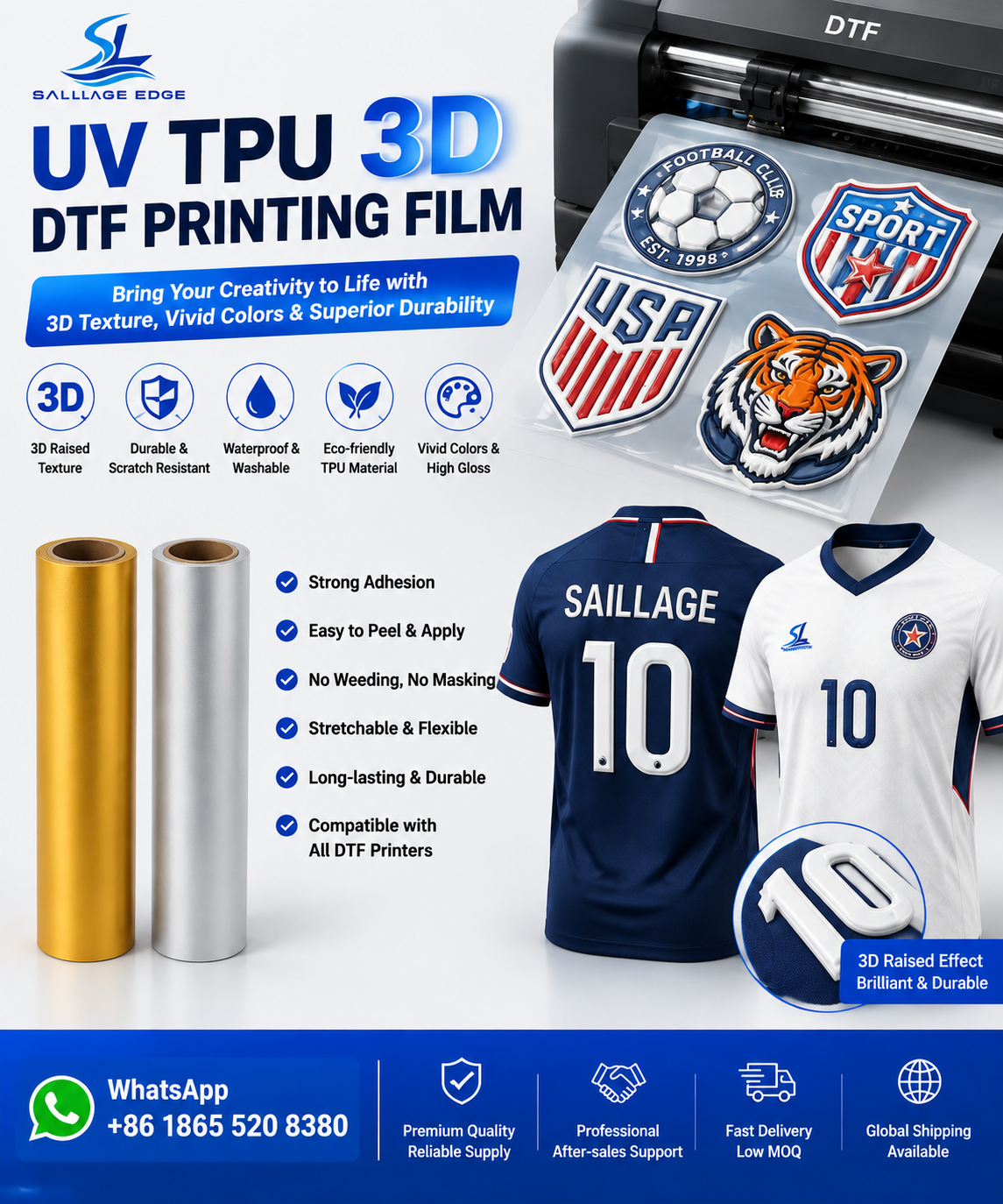
Key Takeaways
· Real 3D embossed effect for premium logo and graphic applications
· Flexible TPU material designed to better accommodate textile movement
· Ultra-high-definition printing for detailed logos and fine graphic elements
· Stable printing and production performance for commercial workflows
· Excellent durability for applications requiring repeated use
· Wide application range across apparel customization and textile decoration
· A more differentiated premium logo transfer solution for B2B printing businesses
Technical Core: How 3D UV DTF TPU Film Works
The main technical difference between traditional DTF film and UV TPU 3D Film lies in the material structure and transfer effect.
Traditional DTF generally produces a relatively flat printed layer. The film serves as the temporary carrier for the printed image before the adhesive layer bonds the design to the textile. This process is effective for high-volume textile decoration, but the final graphic is generally evaluated by color, sharpness, adhesion, and wash durability.
3D UV DTF TPU Film focuses on another performance dimension: surface texture and dimensional appearance.
TPU, or thermoplastic polyurethane, is a polymer material known for its combination of flexibility and mechanical durability. In a transfer-film application, TPU can provide a flexible substrate structure that is better suited to designs where tactile texture and dimensional effects are important.
The technical concept can be considered through three elements:
1. Flexible TPU Material
TPU provides a flexible material base rather than relying on a rigid decorative structure. This is particularly relevant for textile products because garments naturally bend, stretch, and deform during wear.
The file specifically identifies Flexible TPU Material and Eco-Friendly TPU Material as two core product advantages.
2. 3D Texture and Embossed Appearance
The key selling point is the ability to create a real 3D embossed effect. Instead of relying only on color contrast to make a logo visually distinctive, the finished design can provide an additional tactile and dimensional element.
This makes 3D texture transfer film particularly attractive for premium logos, branded apparel, customized garments, and applications where visual differentiation is commercially important.
3. High-Definition Graphic Reproduction
The source material identifies Ultra High Definition Printing as a core advantage.
For logos, this is important because small text, sharp edges, fine graphic details, and brand elements require controlled image reproduction. A premium transfer solution must therefore balance dimensional appearance with print definition rather than simply increasing the visual thickness of the design.
3D UV DTF TPU Film vs. Traditional DTF Film
The two technologies should not be viewed as direct substitutes for every application. Traditional DTF remains highly practical for standard textile graphics, while 3D UV DTF TPU Film is positioned toward applications where premium visual impact, tactile texture, and differentiated logo effects are important.
|
Performance Dimension |
Traditional DTF Film |
3D UV DTF TPU Film |
| Graphic appearance | Primarily flat | 3D / embossed appearance |
| Material concept | Conventional PET transfer structure | Flexible TPU-based structure |
| Logo presentation | Standard decoration | Premium 3D Logo effect |
| Fine details | High-definition graphics | Ultra-high-definition graphics + dimensional effect |
| Textile flexibility | Suitable for standard applications | Designed around flexible TPU characteristics |
| Production focus | General textile printing | Premium logo and textured transfer applications |
| Product differentiation | Moderate | High visual and tactile differentiation |
| Application positioning | General DTF printing | Premium apparel customization and specialty textile decoration |
The comparison above should be understood as a technology-positioning framework, rather than a claim that one film is universally superior. The appropriate choice depends on the customer’s artwork, fabric, production equipment, transfer process, and required finished appearance.
Application & Commercial Solutions
1. Premium Apparel Customization
For apparel customization companies, a printed logo is often more than a decorative element—it represents the brand identity of the garment.
A flat logo may be sufficient for basic promotional apparel. However, fashion brands, premium workwear, sportswear, streetwear, and customized merchandise may require stronger visual differentiation.
3D UV DTF TPU Film can be positioned as a premium logo transfer solution where the dimensional effect becomes part of the product design.
Potential applications include:
• Brand logos on customized apparel
• Premium fashion graphics
• Sportswear branding
• Streetwear decoration
• Customized uniforms
• Promotional garments
• Textile accessories requiring distinctive logo effects
2. Creating a More Premium 3D Logo
One of the strongest commercial advantages of UV TPU 3D Film is its ability to move logo decoration beyond conventional flat printing.
A dimensional logo can create three layers of perception:
Visual → Tactile → Brand Recognition
The customer sees the logo, notices the surface texture, and associates the distinctive finish with a higher-value product.
For B2B buyers, this creates an opportunity to offer different decoration grades:
· Standard DTF for cost-sensitive bulk orders
· 3D UV DTF TPU Film for premium or differentiated products
This segmentation can help printing companies expand their product portfolio without treating every order as a standard flat-printing job.
3. Printing Service Providers
Printing service providers often face two competing requirements: maintaining efficient production while offering enough customization options to differentiate themselves from competitors.
The source material specifically identifies Smooth Printing & Stable Production as a product advantage.
For commercial printing, production stability is particularly important. A visually attractive transfer product still needs a controlled workflow. Stable printing behavior can help reduce unnecessary adjustments, production interruptions, and inconsistent output.
For this reason, product evaluation should consider more than the final appearance. Buyers should also assess:
• Printing consistency
• Film handling
• Compatibility with their production workflow
• Transfer repeatability
• Finished-product durability
• Artwork complexity
• Expected production volume
4. DTF Distributors and Printing Equipment Wholesalers
For distributors, UV DTF TPU Film offers a specialty product category that can complement conventional DTF film, DTF ink, and DTF powder.
Instead of selling only consumables for standard textile printing, distributors can introduce a differentiated solution aimed at customers who want premium logo effects.
The source identifies the primary target customers as DTF distributors, apparel customization companies, printing services, and printing equipment wholesalers.
This creates several commercial opportunities:
• Expand the DTF consumables portfolio
• Offer premium solutions to existing printing customers
• Develop higher-value textile decoration applications
• Provide customers with additional product differentiation
• Build application-specific product packages
How to Select the Right Transfer Film
Before switching from traditional DTF to 3D UV TPU Film, buyers should evaluate the complete application rather than focusing on one specification.
☑ Define the required visual effect
If the application requires a conventional flat graphic, standard DTF may remain the more appropriate solution.
If the customer specifically requires 3D texture, tactile effects, or premium logos, a 3D UV TPU solution becomes more relevant.
☑ Evaluate textile characteristics
Consider fabric composition, surface structure, elasticity, thickness, and end-use conditions.
A flexible transfer material is particularly relevant when the final garment needs to maintain comfortable movement.
☑ Evaluate artwork complexity
Detailed logos require high-definition printing performance. Small text, fine lines, and complex graphic elements should be tested before mass production.
☑ Test production stability
For commercial applications, conduct representative production trials rather than evaluating the film from a single sample.
Test:
· Print quality
· Film handling
· Transfer consistency
· Surface appearance
· Adhesion
· Flexibility
· Durability
☑ Consider the end customer’s positioning
For mass-market, cost-sensitive garments, traditional DTF may provide a more economical solution.
For premium branding, customized apparel, and differentiated products, 3D Logo transfer can provide additional perceived value.
FAQ: 3D UV DTF TPU Film
What is 3D UV DTF TPU Film?
It is a TPU-based transfer-film solution designed for 3D UV DTF printing, with a focus on dimensional and embossed graphic effects. The source material positions it as a 3D texture transfer film and premium logo transfer solution.
What is the main difference between 3D UV TPU Film and traditional DTF Film?
The most important difference is the intended finished effect. Traditional DTF is primarily used for flat textile graphics, while 3D UV TPU Film is designed to provide a more distinctive 3D embossed effect together with flexible TPU characteristics.
Is TPU suitable for flexible textile applications?
TPU is known for its flexible material characteristics, and the source specifically identifies Flexible TPU Material as one of the product’s core advantages. However, final performance depends on the specific film construction, fabric, printing conditions, and transfer process.
Who should consider 3D UV DTF TPU Film?
It is particularly relevant to DTF distributors, apparel customization businesses, printing service providers, and printing equipment wholesalers looking for differentiated premium logo and textile decoration solutions.
Conclusion: From Flat Graphics to Premium 3D Branding
The value of 3D UV DTF TPU Film is not simply the addition of another transfer film to a DTF product portfolio. Its key opportunity lies in combining 3D embossed effects, flexible TPU material, high-definition printing, durability, stable production, and broad application potential into a more differentiated textile decoration solution.
For DTF distributors, apparel customization companies, printing service providers, and equipment wholesalers, the technology provides an additional route to develop premium 3D Logo, Heat Transfer, Textile Printing, and DTF Printing applications.
If you are evaluating UV TPU 3D Film for commercial production, the most practical next step is to test representative artwork and fabrics under your actual printing and transfer conditions. This provides a more reliable basis for evaluating print quality, dimensional appearance, flexibility, durability, and produion stability before purchasing at scale.
Author:Jacky
Post time: Aug-17-2026